
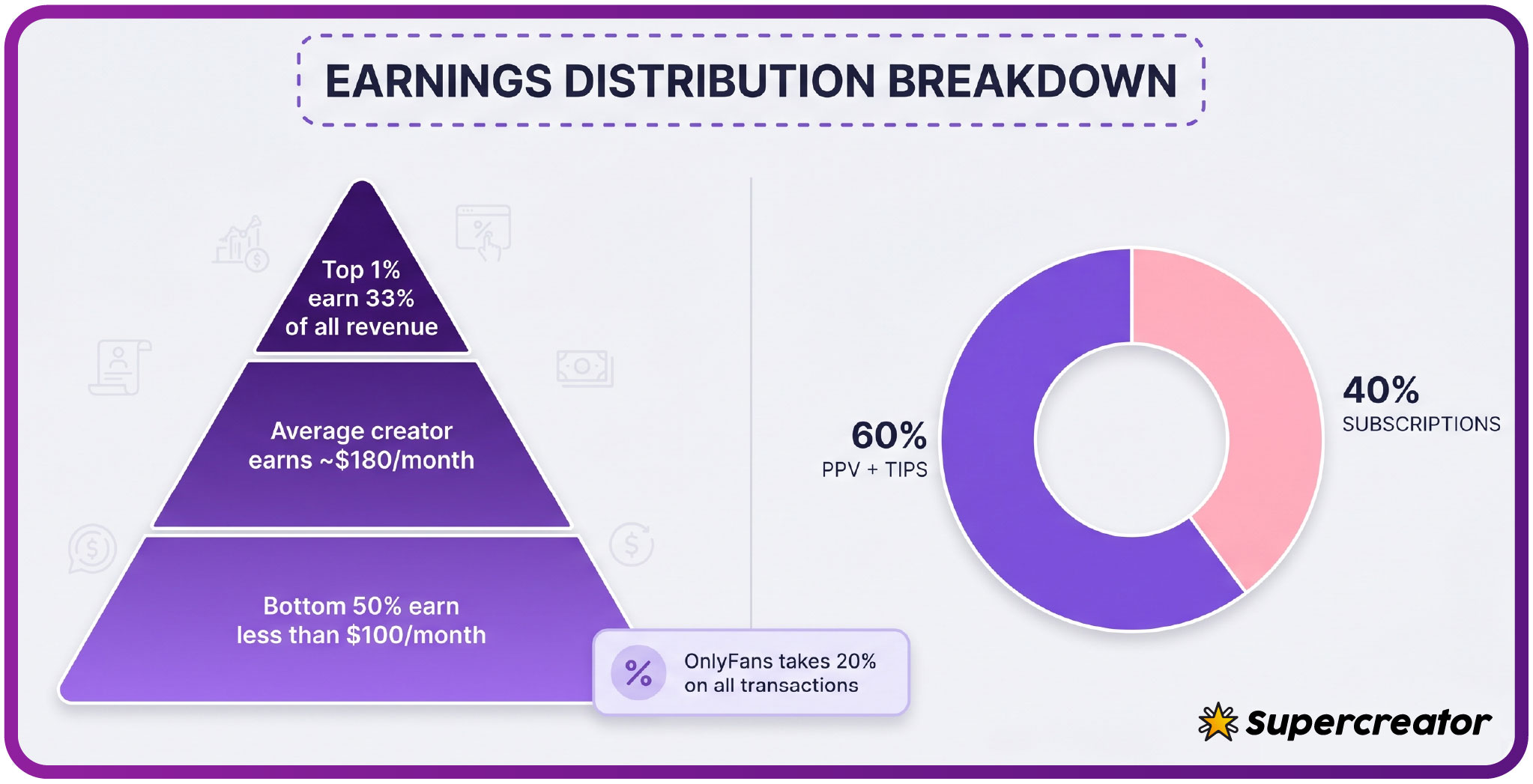
OnlyFans prices look simple on a creator’s page, but the number you see is shaped by a platform fee that never appears on your receipt. The site deducts 20% from every subscription, pay-per-view unlock, tip, and paid message before the creator receives anything. That single mechanic explains why some pages sit at $4.99 while others ask $14.99, and why two creators offering similar content can price themselves very differently. BestOnlyFans readers ask about this constantly, so this guide walks through the arithmetic rather than the marketing.
Creators raise listed prices to protect their take-home pay, and subscribers end up comparing numbers that were never designed to represent the same value. Understanding where the 20% lands, and where it does not, changes how you read every price tag on the platform.

The 20% Fee Structure Behind Every Transaction
- OnlyFans keeps 20% of everything that moves through the platform and passes 80% to the creator.
- The rate is flat, so it does not shrink as transactions get larger.
- A $3 tip and a $50 PPV unlock carry identical platform costs in proportional terms.
- Creators who understand the math stop thinking in gross prices and start thinking in what actually clears.
Subscriptions, PPV messages, and tips all pass through the same 20% deduction. Any pricing decision, from a promotional first month of $3 to a full-price tier, starts from that reality.
Tip: before comparing two pages at different prices, subtract 20% from each listed amount. The gap in creator take-home is usually wider than the gap in what you pay.
There is also no separate line item for the fee on a subscriber’s bank statement, which is why the deduction feels invisible from the buying side. The posted price already contains it, so nothing changes at checkout and nothing appears on your card statement beyond the listed amount.
How Creators Price Around Platform Costs
- Creators rarely set prices by guessing.
- Most work backward from a target monthly income, then add the 20% back on top.
- If a creator wants roughly $8 per subscriber after fees, the listed price has to sit near $9.99.
- Base price rounding: amounts settle on $4.99, $9.99, or $14.99 because those numbers land close to clean post-fee figures.
- PPV bundling: grouping unlocks into one purchase reduces the number of times the fee is applied to small amounts.
- Tip encouragement: creators who expect heavy tipping can price the base subscription lower, since the fee is spread across more revenue streams.
- Custom content premiums: bespoke requests carry higher prices because the creator is pricing their time, not just the media.
- Promotional discount calculations: a first month at $3 is allowed as a promotional rate, but it must still be planned against the 20% cut.
The minimum applies to base subscription prices, which start at $4.99 and run to a maximum of $49.99. Promotional first months can dip below that floor, which is why you occasionally see a $3 introductory offer that later renews at standard pricing.
One mechanic catches subscribers off guard. When a creator raises the price on an existing subscription, auto-renew stops rather than charging you the new figure. Your access continues until the current paid period ends, and you then decide whether the higher number is worth it.

What Subscribers See Versus What Creators Receive
The clearest way to understand the fee is to run the numbers across the tiers you actually encounter. Typical paid subscriptions cluster between $4.99 and $15, with most landing somewhere in the $5 to $10 band.
| Listed Price | Creator Receives | Subscriber Pays |
|---|---|---|
| $4.99 | $3.99 | $4.99 |
| $9.99 | $7.99 | $9.99 |
| $14.99 | $11.99 | $14.99 |
| $24.99 | $19.99 | $24.99 |
The pattern is consistent: a $4.99 subscription returns $3.99 to the creator, and the same one-fifth reduction applies at every tier. Subscribers pay exactly the listed amount, which is why the fee stays invisible from the buying side.
Free pages work differently. A creator sets the price to $0 and earns through PPV messages and tips instead, so the 20% still applies to every unlock.

Platform Fee Impact on PPV Message Pricing
Pay-per-view pricing shows the fee mechanic more sharply than subscriptions, because each unlock is a separate transaction with its own deduction.
- Single unlocks ($3-$15): the entry level, where the fee eats a meaningful share of each small sale.
- Bundled content ($15-$35): several items grouped so the fee is applied once to a larger base.
- Premium unlocks ($35-$50): the ceiling for a single PPV message, usually reserved for rare or custom material.
Paid chat follows the same logic. Replies commonly run $3 to $5 per message, and tips can reach $100, with the 20% taken in every case. The fee does not vary by category, so the difference in what it costs you per transaction is a function of size, not type.
Card verification is the exception worth noting. A $0.10 hold is placed when a card is added to the account and refunded within days, and that is not a fee at all.
Reading Ranking Data Through Fee Awareness
They collect subscription prices, activity signals, and page details into one place so subscribers can compare pages without hunting them down individually.
When you see a cluster of pages at $4.99 to $9.99, you are looking at a market that has already adjusted for the 20% cut. A site that sorts on price alone is sorting on a number that creators chose partly to protect their earnings. BestOnlyFans treats listed prices as one input among several rather than a ranking signal on its own, which matters because the cheapest page is rarely the best value.
A $4.99 subscription with little activity and a $9.99 subscription with consistent posting are not equivalent offers, even though the price gap looks meaningful at a glance. Interactive pages are a good example of why price alone misleads, since custom-request workflows and direct messaging change what a subscription actually delivers. This is part of what makes the best onlyfans interactive comparisons useful: they weigh engagement format alongside the headline number instead of ranking on cost.
Fee Mechanics and Long-Term Budget Planning
Renewals stack while promotional first-month rates expire into standard pricing after the initial period, so a modest habit can drift upward without any single decision feeling large.
- Visible price stability: since fees are baked into listed prices, your bill does not fluctuate with platform-side changes.
- Creator incentive alignment: every creator faces the same 20% cut, so pricing differences reflect positioning rather than hidden costs.
- Content quality investment: creators who price higher are usually funding production, not absorbing the fee alone.
- Platform sustainability: the fee funds hosting, payments, and moderation rather than appearing as a separate charge.
Cancelling a subscription you have not opened in weeks does more for your budget than hunting for a cheaper tier.

Payment security belongs in the same conversation. Card details are stored on the platform, so phishing attempts and card fraud are real concerns for anyone with multiple active subscriptions. Familiarising yourself with phishing attempts and card fraud is worthwhile once you hold several recurring charges on one card.
A card that supports push notification alerts for every charge makes renewal surprises easy to catch early. Two-factor authentication protects access to your account, but it does not protect your card, so the two habits belong together when you manage several subscriptions.
Comparing Net Values Across Similar Price Points
The bands below are not official categories. They are a way of sorting what a creator is motivated to produce at each level and what a subscriber should reasonably expect in return.
| Price Tier | Creator Incentive | Subscriber Value |
|---|---|---|
| $4.99-$6.99 | Volume: attract many subscribers, earn through tips and PPV | Lower entry cost, more upsells |
| $7.99-$9.99 | Balance: steady recurring income at a common price point | Moderate price, expectation of regular posting |
| $10.99-$14.99 | Quality: fewer subscribers, higher per-subscriber return | Higher price, expectation of fuller content |
| $15 and above | Positioning: premium tier with limited audience | Highest cost, clearest case for checking activity first |
After the fee, the creator receives $7.99 and $10.39 respectively, and the extra $2.40 has to be justified by output, not by the size of the gap.
Two subscriptions at $4.99 cost you $9.98 monthly and return $7.98 to creators after fees. That comparison is worth running before adding a third page, because the fee does not reward splitting your budget across more creators.

The platform’s user base expanded sharply around 2020 and has stayed large since, which means creators are pricing into a crowded field. Comparing pages on renewal terms, posting frequency, and message responsiveness tells you more than comparing the headline price alone.

A practical comparison habit is to convert every listed price into its post-fee equivalent before you decide. A page at $14.99 returns $11.99 to the creator, and that figure is the honest measure of how much the page is being funded. When the content does not reflect it, the price tells you the creator is positioning for a smaller, higher-paying audience rather than a broad one.
FAQ
Does the 20% platform fee appear separately on my statement?
The fee is deducted from the creator’s payout before it reaches them, so your statement shows only the listed price. Card verification, by contrast, places a $0.10 hold that is refunded within days and is not a fee at all.
Why do some creators price at $4.99 specifically?
It is the minimum base subscription price and the closest round figure to a $4 take-home after the 20% deduction. Creators who want volume and expect to earn through tips and PPV messages often anchor at that level, while promotional first months can go lower still.
Do creators earn less from PPV messages than subscriptions?
The difference is frequency: each PPV unlock is a separate transaction, so the fee is applied repeatedly to smaller amounts. Subscriptions apply it once per month, which is why recurring revenue is usually steadier for creators.
How does BestOnlyFans account for platform fees in rankings?
Because every creator faces the same 20% deduction, the fee itself does not separate one page from another. Rankings weigh listed prices alongside activity, renewal behavior, and page details, treating price as context rather than a scoring shortcut.
The fee is not a hidden charge you can avoid; it is a structural constant that explains why prices land where they do. Reading listed prices as gross figures, subtracting the 20% in your head, and judging pages on output rather than headline cost keeps your subscription spending honest and your expectations accurate.